

Intro to Projectile Motion
From Algodoo
Intro to Projectile Motion
| Language: | English |
|---|---|
| Description: | Projectile motion can be a very difficult topic for students to grasp because it can be very abstract. The idea of this lab is to help students visualize the x and y component of an object and to see how they combine to create a resultant velocity. |
| Target: | Key Stage 4, Key Stage 5 |
| Category: | Laboratory |
| Discipline: | Motion |
| Learning objectives: |
|
| In class: | Students should be familiar with the Pythagorean Theorem and what it is used for before engaging this activity.
Begin by discussing how you could calculate the velocity of an object moving only in the horizontal or vertical direction. Then expand the question by asking how you could calculate the velocity of an object moving in both the horizontal and the vertical direction. If need be, draw a right triangle to help illustrate the two different velocities of the object. Once the triangle is drawn, ask them if they know a way to calculate the length of the hypotenuse of the triangle. Lastly, have students reinforce this idea by engaging the corresponding activity allowing them to use the Create – Predict –Interact – Evaluate model. |
CREATE A SCENE
RUN/INTERACT
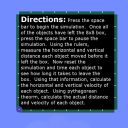
Next, use the back button to reset the simulation. One by one, time how long it takes for each object to leave the 8x8 meter box and record your data in your data table.
Lastly, calculate the horizontal speed of each object using the time you measured and the horizontal distance it traveled as well as the vertical speed using the vertical distance measured.
The object’s horizontal and vertical speeds serve as the horizontal and vertical legs of a right triangle. Using this information, calculate the actual speed of each object (hypotenuse) using Pythagorean Theorem.
EVALUATE
REVISE SCENE

