
"Plain English" "onCollision" Events
"Plain English" "onCollision" Events
 by Psmith » Mon Dec 28, 2009 1:52 am
Since there is a large audience of "non-coding" users of Algodoo, there should and could be an entire category of actions and reactions that could be initialized and enabled for collision events that require no use of "coding".
Some examples would be: animation sequence triggers, motors starting and stopping, springs enabled and disabled, movement starting and stopping, gravity enabled and disabled, fixates enabled and disabled.
There are many more actions and reactions that could be put to use in this fashion. Feel free to add to the list.
Psmith
- Psmith
- Posts: 8
- Joined: Thu Dec 24, 2009 5:31 pm
Re: "Plain English" "onCollision" Events
by Chronos » Tue Dec 29, 2009 3:52 pm
TheWinkits wrote:They both looks of cuking amazing
-

Chronos - [Most Active Member 2010]
- Posts: 4457
- Joined: Mon Aug 31, 2009 6:00 pm
- Location: Californania
Re: "Plain English" "onCollision" Events
by Psmith » Wed Dec 30, 2009 1:59 am
And why do you think its a good thing for people "not to know it"?
Psmith
- Psmith
- Posts: 8
- Joined: Thu Dec 24, 2009 5:31 pm
Re: "Plain English" "onCollision" Events
by RicH » Wed Dec 30, 2009 5:26 pm
Chronos wrote:Algodoo is a physics engine. Not a coding engine.
Quote for emphasis.
-

RicH - [Funniest Person 2010]
- Posts: 2043
- Joined: Tue Sep 01, 2009 9:01 am
Re: "Plain English" "onCollision" Events
by Chronos » Wed Dec 30, 2009 5:30 pm
Psmith wrote:Chronos:
And why do you think its a good thing for people "not to know it"?
Psmith
Rich pretty much said why. People should focus more on the mechanical aspect of Algodoo and not the coding one.
TheWinkits wrote:They both looks of cuking amazing
-
Chronos - [Most Active Member 2010]
- Posts: 4457
- Joined: Mon Aug 31, 2009 6:00 pm
- Location: Californania
Re: "Plain English" "onCollision" Events
by Versieon » Wed Dec 30, 2009 5:39 pm
Most of this is already possible with Thyme.
And yet you just said this.

Thats probobly why simple thyme commands would be easyer for most, then they could make built in chalenges without having to be realy good at thyme.
-

Versieon - Posts: 375
- Joined: Tue Sep 01, 2009 4:45 pm
Re: "Plain English" "onCollision" Events
by RA2lover » Wed Dec 30, 2009 5:57 pm
Jrv wrote:TC42 wrote:Quite honestly, I didn't think anyone on 4chan has that good a use of grammar, spelling, usage, mechanics, ect.
But I've never been there, so I may be wrong.
GTFO newfgt
-

RA2lover - Posts: 607
- Joined: Mon Aug 31, 2009 8:43 pm
- Location: Brazil
Re: "Plain English" "onCollision" Events
by Chronos » Wed Dec 30, 2009 7:58 pm
Versieon wrote:Most of this is already possible with Thyme.
And yet you just said this.
Because if you know enough Thyme, you make it. If you don't ask someone else to.
TheWinkits wrote:They both looks of cuking amazing
-
Chronos - [Most Active Member 2010]
- Posts: 4457
- Joined: Mon Aug 31, 2009 6:00 pm
- Location: Californania
Re: "Plain English" "onCollision" Events
by Psmith » Wed Dec 30, 2009 8:15 pm
Oh, I see. Keep advanced functionality out of the hands of the "non-pros". In other words, there needs to be an "inside group", an Algodoo priesthood, so that the "layman" needs to consult with an Algodoo priest if he wants to create anything using "logic".
Keep it difficult to keep out the uninitiated.
Makes good sense.
Psmith
- Psmith
- Posts: 8
- Joined: Thu Dec 24, 2009 5:31 pm
Re: "Plain English" "onCollision" Events
by Chronos » Thu Dec 31, 2009 1:56 am
Understand?
TheWinkits wrote:They both looks of cuking amazing
-
Chronos - [Most Active Member 2010]
- Posts: 4457
- Joined: Mon Aug 31, 2009 6:00 pm
- Location: Californania
Re: "Plain English" "onCollision" Events
by gradyfitz » Thu Dec 31, 2009 5:29 am
Psmith wrote:Chronos:
Oh, I see. Keep advanced functionality out of the hands of the "non-pros". In other words, there needs to be an "inside group", an Algodoo priesthood, so that the "layman" needs to consult with an Algodoo priest if he wants to create anything using "logic".
Keep it difficult to keep out the uninitiated.
Makes good sense.
Psmith
At the moment, Thyme is an extremely simple language (to me at least), I think it's very easy to understand and use, of course, there are those who don't know how to use Thyme, but there are quite a few tutorials around explaining how to do various things in thyme (like my tutorial or Paradigm29's basic onCollide scripting video for example), Thyme is an important part yes, but there are only certain areas it is applicable, and chances are, you don't need it if you can't easily understand these tutorials (provided you're english
 ), for example, the main reasons you might need to understand thyme are graphical effects or infinite source of something or for perfect precision object creation, for the majority of situations, physics will do
  , if you don't know how to move something along a certain path, there are methods of doing so without any thyme.
Thyme is like an extension, so you can optimize your situation, and build a more resource heavy situation, or build things that are simply impossible to simulate on a large enough scale like for example, simulating realistic physics. Most things can be achieved without thyme
, the main advantage of Thyme is optimization, and if you require optimization, it's for one easier to do it yourself than for you to say "optimize" to the program (as if this happened, it would only be minor optimizations), and also, if you need to optimize something, generally, you can get someone to do what you want to do (like for example, if you need some plain English translations to thyme, I'm pretty sure people here would be able to help you, and would (if not, people can always message me, I'll be glad to help)), and also, "if he wants to create anything using "logic"", I'm not sure what this means, because you can just use logic gates for that, or, build a mechanism to run the same thing. The hardest part of Thyme is maths (not very hard for me ), but that is involved in normal physics calculations that you use (or at least, for me it is).I don't think Thyme needs to change it's method, it's simple enough as it is
, if you need help with something, just ask, the users here are pretty friendly and willing to help . Keep in mind that even some of the top level Thyme users ask for help .- Grady
- gradyfitz
- Posts: 174
- Joined: Tue Sep 01, 2009 8:33 am
- Location: Victoria, Australia
Re: "Plain English" "onCollision" Events
by izacque » Thu Dec 31, 2009 4:55 pm
gradyfitz wrote:At the moment, Thyme is an extremely simple language (to me at least), I think it's very easy to understand and
...
simple enough as it is
- Grady
exactly. tutorials are the way to go. If you can't understand the tutorials, then you have no business messing around with thyme.
Paradigm 29 wrote:I've been trying to figure out why people even buy hummers ever since I found out that they don't have machine guns.
-

izacque - Posts: 483
- Joined: Mon Sep 14, 2009 11:14 am
Re: "Plain English" "onCollision" Events
by Psmith » Fri Jan 01, 2010 8:53 pm
I just think scripting needs to emerge from the stone age and become something friendly and understandable for anyone to just pick up and use. Maybe not, at first, for every kind of event that Thyme was designed to address, but, at least, for the most common "physical" events, starting with collisions and motors and basic x,y movement.
In case you think that programming languages have to be cryptic and "code-like" in order function properly and be fast, there are plenty of alternatives to "scripting" that don't look anything like the "C" "language".
In case you haven't taken the time: http://www.runrev.com/
I suggest something understandable, (in plain English, or any spoken language), like "Rev" for creating processes that Algodoo understands.
There should be no reason for people to be forced to wrap their minds around symbolic, not readily comprehensible code. Nor, for them to depend on the priesthood of the code to get things done.
Psmith
- Psmith
- Posts: 8
- Joined: Thu Dec 24, 2009 5:31 pm
Re: "Plain English" "onCollision" Events
by RA2lover » Fri Jan 01, 2010 11:04 pm
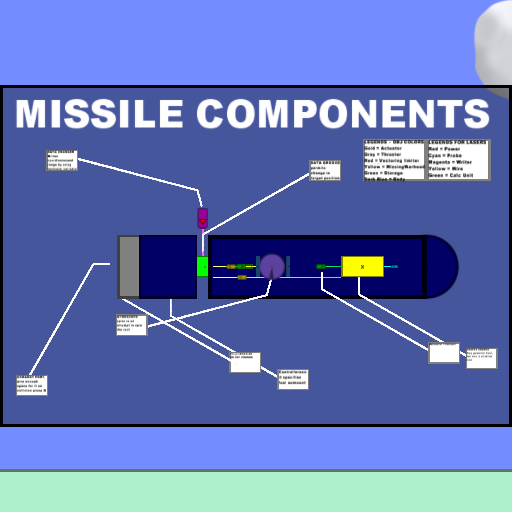


the thing to luck upon is to the warhead itself. else, how would a computer program be able to understand in english "check if target is within range. if so, spawn 48 circles in a tight pattern facing the missile's front forming an arc with individually preset velocities, and custom changed density, color, programmed individually to disappear upon colliding with something after moving it along, then make the mechanism un-usable for later use". and that wouldn't let to set some things like the angle on which they form onto, and similar.
wow, what a wall of text

Jrv wrote:TC42 wrote:Quite honestly, I didn't think anyone on 4chan has that good a use of grammar, spelling, usage, mechanics, ect.
But I've never been there, so I may be wrong.
GTFO newfgt
-
RA2lover - Posts: 607
- Joined: Mon Aug 31, 2009 8:43 pm
- Location: Brazil
Re: "Plain English" "onCollision" Events
by Psmith » Sat Jan 02, 2010 1:47 am
Even an English-like language written to instruct a machine through a series of process steps would have to be written with a particular syntax - it would limit which words could be used in a statement and under what conditions. It would simply be more readable to "ordinary" users than Thyme code.
Kodu by Microsoft has what seems to be an ideal combination of phrases and pictures which, when combined, are capable of producing extremely complex behaviour, and that, in record time.
Psmith
- Psmith
- Posts: 8
- Joined: Thu Dec 24, 2009 5:31 pm
Re: "Plain English" "onCollision" Events
by gradyfitz » Sat Jan 02, 2010 3:14 am
Psmith wrote:It might result in a very large wall of text, but you could intersperse with predefined pictures where they are more economical. Even so, that wall of text, if punctuated properly, and assuming the author could write comprehensible commands, would remain intelligible forever, to all readers of the language it was written in, (English).
Even an English-like language written to instruct a machine through a series of process steps would have to be written with a particular syntax - it would limit which words could be used in a statement and under what conditions. It would simply be more readable to "ordinary" users than Thyme code.
Kodu by Microsoft has what seems to be an ideal combination of phrases and pictures which, when combined, are capable of producing extremely complex behaviour, and that, in record time.
Psmith
Though what if you had to put some advanced systems in? The text you placed in would be much more confusing than your original code, for example...
A simple code like this:
- Code: Select all
Scene.my.SpawnMech = (a1,a2,a3,a4,a5,a6,a7,a8,c5,c6,c7,c8,d5,d6,d7,d8,e1,e2,e3,e4,e5,e6,e7,e8,p1,p2,p3,p4,p5,p6,p7,p8)=>{

    Scene.addBox{size := [0.01,0.01];pos := [c5,d5];color := [0,0,0,1];geomID := 25;body := 0;collideSet := 0;density := 1e+006};
   Scene.addBox{size := [0.01,0.01];pos := [c6,d6];color := [0,0,0,1];geomID := 26;body := 0;collideSet := 0;density := 1e+006};
   Scene.addBox{size := [0.01,0.01];pos := [c7,d7];color := [0,0,0,1];geomID := 27;body := 0;collideSet := 0;density := 1e+006};
   Scene.addBox{size := [0.01,0.01];pos := [c8,d8];color := [0,0,0,1];geomID := 28;body := 0;collideSet := 0;density := 1e+006};
   a5 != 0 ? {Scene.addBox{size := [0.01,Scene.my.abs(a5)];pos := [c5,d5] - ([Math.sin(e5),Math.cos(e5)] * (a5 / 2.0));color := [1,0,0,1];angle = -(e5 - Math.pi);geomID := 15;collideSet := 0;density := 1e+006}} : {};
   a6 != 0 ? {Scene.addBox{size := [0.01,Scene.my.abs(a6)];pos := [c6,d6] - ([Math.sin(e6),Math.cos(e6)] * (a6 / 2.0));color := [0,1,0,1];angle = -(e6 - Math.pi);geomID := 16;collideSet := 0;density := 1e+006}} : {};
   a7 != 0 ? {Scene.addBox{size := [0.01,Scene.my.abs(a7)];pos := [c7,d7] - ([Math.sin(e7),Math.cos(e7)] * (a7 / 2.0));color := [0,0,1,1];angle = -(e7 - Math.pi);geomID := 17;collideSet := 0;density := 1e+006}} : {};
   a8 != 0 ? {Scene.addBox{size := [0.01,Scene.my.abs(a8)];pos := [c8,d8] - ([Math.sin(e8),Math.cos(e8)] * (a8 / 2.0));color := [1,1,0,1];angle = -(e8 - Math.pi);geomID := 18;collideSet := 0;density := 1e+006}} : {};
    a1 != 0 ? {Scene.addBox{size := [0.01,Scene.my.abs(a1)];pos := ([c5,d5] - ([Math.sin(e5),Math.cos(e5)] * (a5)) - ([Math.sin(e1),Math.cos(e1)] * (a1 / 2.0)));color := [1,0,0,1];angle = -(e1 - Math.pi);geomID := 11;collideSet := 0;density := 1e+006}} : {};
    a2 != 0 ? {Scene.addBox{size := [0.01,Scene.my.abs(a2)];pos := [c6,d6] - ([Math.sin(e6),Math.cos(e6)] * (a6)) - ([Math.sin(e2),Math.cos(e2)] * (a2 / 2.0));color := [1,1,0,1];angle = -(e2 - Math.pi);geomID := 12;collideSet := 0;density := 1e+006}} : {};
    a3 != 0 ? {Scene.addBox{size := [0.01,Scene.my.abs(a3)];pos := [c7,d7] - ([Math.sin(e7),Math.cos(e7)] * (a7)) - ([Math.sin(e3),Math.cos(e3)] * (a3 / 2.0));color := [0,1,1,1];angle = -(e3 - Math.pi);geomID := 13;collideSet := 0;density := 1e+006}} : {};
    a4 != 0 ? {Scene.addBox{size := [0.01,Scene.my.abs(a4)];pos := [c8,d8] - ([Math.sin(e8),Math.cos(e8)] * (a8)) - ([Math.sin(e4),Math.cos(e4)] * (a4 / 2.0));color := [1,1,1,1];angle = -(e4 - Math.pi);geomID := 14;collideSet := 0;density := 1e+006}} : {};
    /* Bars
*/
   h1pos := ([c5,d5] - ([Math.sin(e5),Math.cos(e5)] * (a5)) - ([Math.sin(e1),Math.cos(e1)] * (a1)));
   h2pos := ([c6,d6] - ([Math.sin(e6),Math.cos(e6)] * (a6)) - ([Math.sin(e2),Math.cos(e2)] * (a2)));
   h3pos := ([c7,d7] - ([Math.sin(e7),Math.cos(e7)] * (a7)) - ([Math.sin(e3),Math.cos(e3)] * (a3)));
   h4pos := ([c8,d8] - ([Math.sin(e8),Math.cos(e8)] * (a8)) - ([Math.sin(e4),Math.cos(e4)] * (a4)));
   Scene.addBox{pos := ((h1pos + h2pos) / 2.0);angle := (Math.atan(-((h1pos(0) - h2pos(0))) / ((h1pos(1) - h2pos(1)))));geomID := 20;size := [0.01,10];collideSet := 1;density := 45}; // GeomID = 20
   Scene.addBox{pos := ((h3pos + h4pos) / 2.0);angle := (Math.atan(-((h3pos(0) - h4pos(0))) / ((h3pos(1) - h4pos(1)))));geomID := 19;size := [0.01,10];collideSet := 2;density := 45}; // GeomID = 19

   /* Rails
   Build rails here
   */
   b1ang := (Math.atan(-((h1pos(0) - h2pos(0))) / ((h1pos(1) - h2pos(1)))));
   b2ang := (Math.atan(-((h3pos(0) - h4pos(0))) / ((h3pos(1) - h4pos(1)))));
   Scene.addBox{geomID := 21;body := 101;angle := b2ang;pos := h3pos;size := [0.03,0.04];collideSet := 0;density := 1e+006}; // geomID 21 - Base box 1 - p4 - body 101 - size 3x
   Scene.addBox{geomID := 22;body := 102;angle := b1ang;pos := h2pos;size := [0.03,0.04];collideSet := 0;density := 1e+006}; // geomID 22 - Base box 2 - 42 - body 102
   Scene.addBox{body := 101;angle := (b2ang);pos := (h3pos + ([Math.cos(b2ang),Math.sin(b2ang)] * 0.01));size := [0.01,0.04];collideSet := 2;density := 1e+006}; // geomID 23 - Side rail 1 - box 1 - body 101 - geomID not important
   Scene.addBox{body := 101;angle := (b2ang);pos := (h3pos - ([Math.cos(b2ang),Math.sin(b2ang)] * 0.01));size := [0.01,0.04];collideSet := 2;density := 1e+006}; // geomID 24 - Side rail 2 - box 1 - body 101 - geomID not important
   Scene.addBox{body := 102;angle := (b1ang);pos := (h2pos + ([Math.cos(b1ang),Math.sin(b1ang)] * 0.01));size := [0.01,0.04];collideSet := 1;density := 1e+006}; // geomID 29 - Side rail 1 - box 2 - body 102 - geomID not important
   Scene.addBox{body := 102;angle := (b1ang);pos := (h2pos - ([Math.cos(b1ang),Math.sin(b1ang)] * 0.01));size := [0.01,0.04];collideSet := 1;density := 1e+006}; // geomID 30 - Side rail 2 - box 2 - body 102 - geomID not important
   /* Hinge Spawns
   */

   h5pos := [c5,d5] - ([Math.sin(e5),Math.cos(e5)] * (a5));
   h6pos := [c6,d6] - ([Math.sin(e6),Math.cos(e6)] * (a6));
   h7pos := [c7,d7] - ([Math.sin(e7),Math.cos(e7)] * (a7));
   h8pos := [c8,d8] - ([Math.sin(e8),Math.cos(e8)] * (a8));

   a8 != 0 ? {Scene.addHinge{pos := h8pos;geom0 := 18; geom1 := 14;motorSpeed := 0.2;motor := true;motorTorque := +inf};   Scene.addHinge{pos := [c8,d8];geom0 := 28;geom1 := 18;motorSpeed := 0.1;motor := true;motorTorque := +inf}} : {Scene.addHinge{pos := [c8,d8];geom0 := 28;geom1 := 14}};
   a7 != 0 ? {Scene.addHinge{pos := h7pos;geom0 := 17; geom1 := 13;motorSpeed := 0.2;motor := true;motorTorque := +inf};   Scene.addHinge{pos := [c7,d7];geom0 := 27;geom1 := 17;motorSpeed := 0.1;motor := true;motorTorque := +inf}} : {Scene.addHinge{pos := [c7,d7];geom0 := 27;geom1 := 13}};
   a6 != 0 ? {Scene.addHinge{pos := h6pos;geom0 := 16; geom1 := 12;motorSpeed := 0.2;motor := true;motorTorque := +inf};   Scene.addHinge{pos := [c6,d6];geom0 := 26;geom1 := 16;motorSpeed := 0.3;motor := true;motorTorque := +inf}} : {Scene.addHinge{pos := [c6,d6];geom0 := 26;geom1 := 12}};
   a5 != 0 ? {Scene.addHinge{pos := h5pos;geom0 := 15; geom1 := 11;motorSpeed := 0.2;motor := true;motorTorque := +inf};   Scene.addHinge{pos := [c5,d5];geom0 := 25;geom1 := 15;motorSpeed := 0.3;motor := true;motorTorque := +inf}} : {Scene.addHinge{pos := [c5,d5];geom0 := 25;geom1 := 11}};
   a4 != 0 ? {Scene.addHinge{pos := h4pos;geom0 := 14; geom1 := 19}} : {}; // hinge
   a3 != 0 ? {Scene.addHinge{pos := h3pos;geom0 := 13; geom1 := 21}} : {};
   a2 != 0 ? {Scene.addHinge{pos := h2pos;geom0 := 12; geom1 := 22}} : {};
   a1 != 0 ? {Scene.addHinge{pos := h1pos;geom0 := 11; geom1 := 20}} : {}; // hinge

};
Would become very difficult to understand.
"Create a new function called Scene.my.SpawnMech which takes twenty-four arguments, a1,a2,a3,a4,a5,a6,a7,a8,c5,c6,c7,c8,d5,d6,d7,d8,e1,e2,e3,e4,e5,e6,e7 and e8, first with these arguments, create a box, the size of which is 0.01m across and 0.01 up, with the position on the x axis at the co-ordinate defined by c5, and the position on the y axis at the co-ordinate defined by d5, with the colour of this box being black, with the geometry identification number being 25, and the box being connected to body 0, with no collisions on the collision set, and a density of 1 million kg/m^2... " that being for just the first two lines. 2 lines into 6 doesn't exactly make it easier to read
. Continuing on a bit later:On the line "b1ang := (Math.atan(-((h1pos(0) - h2pos(0))) / ((h1pos(1) - h2pos(1)))));" you would end up with it turning into "Declare a new identifier named b1ang and assign it to the inverse tangent of the negative value of h2pos's x co-ordinate subtracted from h1pos's x co-ordinate and divided by h2pos's y co-ordinate subtracted from h1pos's y co-ordinate ", that is no easier to understand than the original, and the original is very easy to understand on top of that, the difficult parts to understand are much harder to understand in plain English.
Sure you could just type "Generate an optimally built trigonometric drawing system that draws a 2", but, of course, that wouldn't be an easy thing for a program to understand, because on top of all the mathematical equations required, you also need to know what "2" the user wants, do they want a digital two, a terribly drawn "2" or a binary "2"?
If you really think this feature is important, you could probably build a program that translated plain English into Thyme code, I thought I'd do this once but never got around to it, also, didn't think it was worth it.
It's simpler and easier to understand Thyme than plain English saying the same thing
, variable names and functions are pretty self-explanatory and infixed operations are generally self explanatory as well ("=","+","/","*","-"), also, things that generally people don't understand are things that you can't really express easily in English, like for example, "Assign spring length dynamically to modify Scene.my.X to damping and spring length also equal to 10".In conclusion, putting them in "Plain English" would not necessarily make it easy to use as you may think, because even if the interpreter was able to read it all correctly, it would be ridiculously difficult to read it for full codes (keep in mind my examples only follow a few lines when actual scripts I make are about a thousand lines long, which would probably expand to about 3000 lines or 4000 lines or so, which would take an extremely long to type, also, 6000 lines would probably take an hour or so to read or something).
It's not worth it
, Thyme used to be confined to an extremely small group, like 3 or 4 users that were able to use it very well and 1 or 2 that were able to do interesting things in scenes using it, but then someone wrote a tutorial, which resulted in most people being able to use Thyme, it's a very simple language now that has a very large number of capabilities, and some users have even created programs that interface with objects in Algodoo, like Externet for example allowing users to connect online and send messages to each other through Algodoo, or a system allowing a user to extract the system time just by running one program (communication.cfg is very useful for this ).It's easy to learn Thyme, and if you have trouble learning it, just ask for help
, Thyme is basically in English with infixed symbols and shortened text.I still don't think there is much benefit having it in "Plain English" except that people don't need to read or watch a few videos, though scripting is in Advanced Mode, so I don't think that needing to read up on a bit of data is much of a problem.
- Grady
- gradyfitz
- Posts: 174
- Joined: Tue Sep 01, 2009 8:33 am
- Location: Victoria, Australia
Re: "Plain English" "onCollision" Events
by niffirg1 » Sat Jan 02, 2010 6:12 am
-

niffirg1 - Posts: 376
- Joined: Mon Aug 31, 2009 10:31 pm
- Location: The Great American South!
Re: "Plain English" "onCollision" Events
by standardtoaster » Sat Jan 02, 2010 6:22 am
If you are a quick learner, after about a day or so, you should be able to get quite a lot of it. Another thing that can help quite a lot is to study scenes that are scripting intensive.-

standardtoaster - Posts: 606
- Joined: Mon Aug 31, 2009 7:57 pm
Re: "Plain English" "onCollision" Events
by Psmith » Sat Jan 02, 2010 8:06 am
A clock timer could be placed as an object in the simulation window and visibly linked to another object, (a motor, for example), and adjusted to start or stop the motor after period of time. All such visible process controls could reside on a special process layer, thus rendering them easy to display or hide.
Electrical switches would come in very handy.
By just adding these few "plain" commands or devices, 10's of thousands of variations in physics "play" open up to the average user. If the commands could either be represented by descriptive icons or text or a combination of both, by entering them directly in the simulation window, the user could then "draw" the link between the command and which object it is designed to control.
This way, not only the static physical properties of each item would be represented in the simulation window, but all of the actions and reactions, and time based triggers would be visible, giving the user "foreknowledge" of what is "going to happen" if and when.
This method of describing physical processes is much more akin to what goes on in any complex factory or automated lab, thus serving as a vehicle to help students and other users to visualize "real world" physical phenomenon and more complex simulations than are now possible.
Thyme will never go away and be available for any advanced users who need to create other types of complex systems that require the use of arrays and database retrieval operations.
Psmith
- Psmith
- Posts: 8
- Joined: Thu Dec 24, 2009 5:31 pm
Re: "Plain English" "onCollision" Events
by RicH » Sat Jan 02, 2010 8:20 am
-
RicH - [Funniest Person 2010]
- Posts: 2043
- Joined: Tue Sep 01, 2009 9:01 am
Re: "Plain English" "onCollision" Events
by isaacwaller » Sat Jan 02, 2010 8:32 am
- isaacwaller
- Posts: 9
- Joined: Fri Dec 25, 2009 12:11 am
- Location: Canada
Re: "Plain English" "onCollision" Events
by RicH » Sat Jan 02, 2010 9:39 am
emilk wrote:I'd like to create a visual programming language for this, since most people aren't that keen on learning a scripting language to do stuff. Exactly how this will be done is yet to be decided.
Old but hey, it's from emil

-
RicH - [Funniest Person 2010]
- Posts: 2043
- Joined: Tue Sep 01, 2009 9:01 am
Re: "Plain English" "onCollision" Events
by Chronos » Sat Jan 02, 2010 10:31 pm
isaacwaller wrote:I think this is ridiculous. If Algodoo is a "physics engine" and not a "coding engine", why does Thyme exist? Yes, Algodoo is primarily a physics simulator. But there's a lot you can't do with just the physics part, and you shouldn't hide all that functionality from the normal user. A simple "Events" menu with "On collision" drop down menus, with items such as "Simulate key 'x'" and "Destroy myself" would be extremely great for the novice user.
Thyme is in Algodoo for reducing lag. Plus, without Thyme, Algodoo wouldn't run. All the objects, all the scene parameters, just about everything is made with Thyme. Emil just thought that it should be more accessible, but you should still learn it. I really don't like the idea of a visual scripting language in Algodoo, because those who've already learned Thyme would have trouble with it. Thyme is more powerful than you think, and easier too. Learn it if you want, but if you don't want to, then stay mechanical. It's better than way anyway. Even I know Thyme but I don't use it much.
TheWinkits wrote:They both looks of cuking amazing
-
Chronos - [Most Active Member 2010]
- Posts: 4457
- Joined: Mon Aug 31, 2009 6:00 pm
- Location: Californania
Re: "Plain English" "onCollision" Events
by Versieon » Tue Jan 05, 2010 2:53 am
I really don't like the idea of a visual scripting language in Algodoo, because those who've already learned Thyme would have trouble with it.
I don't think he is pushing for the deletion of Thyme, you could still use it as you would now, just the implementation of a easyer to understand and more visual interface that could be used by begining users( and even advanced users to reduce the amount of coding for simple actions) to create basic scenens that require thyme without going through the proceces of learning the language.
-
Versieon - Posts: 375
- Joined: Tue Sep 01, 2009 4:45 pm
Re: "Plain English" "onCollision" Events
by Chronos » Tue Jan 05, 2010 4:35 am
TheWinkits wrote:They both looks of cuking amazing
-
Chronos - [Most Active Member 2010]
- Posts: 4457
- Joined: Mon Aug 31, 2009 6:00 pm
- Location: Californania
Who is online
Users browsing this forum: No registered users and 2 guests


