
How to measure power of engines?
10 posts • Page 1 of 1
How to measure power of engines?
 by Ravenplucker » Thu May 26, 2011 12:46 pm
Is there any way for me to calculate the power of engines? Like some sort of test, machine or calculation?
TheWonkits wrote:You can't do cartwheels when you're bored. Biological impossibility; they're fueled by joy.
Phundamentalist
- Ravenplucker
- Posts: 644
- Joined: Thu Jan 06, 2011 6:22 pm
- Location: Sydney, Australia
Re: How to measure power of engines?
by Kilinich » Thu May 26, 2011 1:07 pm
I've make few machines for power measurement.
First one was for phun
The idea is attach script-controlled motor and rpm meter, set high motor strength and decrease it until rpm will be more than rpm for scripted motor. At this point you have real motor strength @ RPM.
First one was for phun
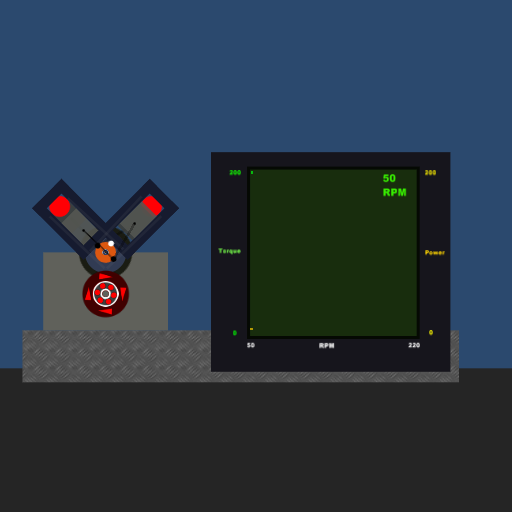


The idea is attach script-controlled motor and rpm meter, set high motor strength and decrease it until rpm will be more than rpm for scripted motor. At this point you have real motor strength @ RPM.
Dream of Algodoo as game development engine...
-

Kilinich - [Best bug reporter 2010]
- Posts: 2098
- Joined: Mon Aug 31, 2009 8:27 pm
- Location: South Russia
Re: How to measure power of engines?
by Ravenplucker » Thu May 26, 2011 1:21 pm
What is the difference between power and torque?
TheWonkits wrote:You can't do cartwheels when you're bored. Biological impossibility; they're fueled by joy.
Phundamentalist
- Ravenplucker
- Posts: 644
- Joined: Thu Jan 06, 2011 6:22 pm
- Location: Sydney, Australia
Re: How to measure power of engines?
by Ravenplucker » Thu May 26, 2011 2:14 pm
I think I'm doing something wrong. No matter what I use, it still traces out the same line on the plotter.
TheWonkits wrote:You can't do cartwheels when you're bored. Biological impossibility; they're fueled by joy.
Phundamentalist
- Ravenplucker
- Posts: 644
- Joined: Thu Jan 06, 2011 6:22 pm
- Location: Sydney, Australia
Re: How to measure power of engines?
by Someone Else » Thu May 26, 2011 3:42 pm
Torque is measured in newton-meters, power is newton-meters divided by time.
The torque is how much force the engine can put out, how steep a hill a car powered by it can climb, while the power is how much torque divided by how long you run it. How fast it can climb the hill.
The torque is how much force the engine can put out, how steep a hill a car powered by it can climb, while the power is how much torque divided by how long you run it. How fast it can climb the hill.
Matthias Wandel is epic, in my humble opinion.
I love my brain...
ARE YA HAPPY NOW?????
Thymechanic/Phundamentalist
Recently, I discovered something a lot of you probably already knew: Minecraft is awesome.
Due to this, I may not be as active as usual for a while.
I love my brain...
TC42 wrote:Also, your sig is too big, please change it.
ARE YA HAPPY NOW?????
Thymechanic/Phundamentalist
Recently, I discovered something a lot of you probably already knew: Minecraft is awesome.
Due to this, I may not be as active as usual for a while.
-

Someone Else - Posts: 1147
- Joined: Sun Nov 21, 2010 10:53 pm
- Location: The Milky Way Galaxy
Re: How to measure power of engines?
by Ravenplucker » Tue Jul 05, 2011 5:24 am
*bump*
If I used gear ratios to make all the engines approximately the same speed, would I be able to measure power by connecting it to a rack and pinion and seeing how much weight it can lift?
If I used gear ratios to make all the engines approximately the same speed, would I be able to measure power by connecting it to a rack and pinion and seeing how much weight it can lift?
TheWonkits wrote:You can't do cartwheels when you're bored. Biological impossibility; they're fueled by joy.
Phundamentalist
- Ravenplucker
- Posts: 644
- Joined: Thu Jan 06, 2011 6:22 pm
- Location: Sydney, Australia
Re: How to measure power of engines?
by Someone Else » Tue Jul 05, 2011 11:33 am
That would certainly let you know about torque. Really, I'm not completely sure what exactly power is... [other than work divided by time, which is useless]
***Wikipedia***
Okay, this is combined from 7th grade physics and Wikipedia. Not copy-pasted from anywhere except my brain.
Work is performed when a force exerted on something and the direction it's moving are not perpendicular.
So, picking up a bag of groceries and lifting it up above your head results in work being done. You apply a force upwards and the bag moves upwards. You do work on the bag.
You then, still holding the bag above your head, walk over to the shopping cart. You still apply an upward force, but now the bag moves horizontally. These two vectors are now perpendicular, so you no longer do work on the bag. You can think of this as replacing yourself with a frictionlessly sliding platform- Give it a push and it keeps sliding. No work is being done.
You then gently lower the bag into the cart, as if it were filled with raw eggs. It is, but this is irrelevant.
The two aforementioned vectors- velocity and force- are now antiparallel- they point in opposite directions. However, they are not perpendicular, so you once more do work on the bag.
Work is usually expressed in newton-meters. Believe it or not, You must, or else I will take the aforementioned bag of eggs and chuck it at you, but this too is irrelevant.no matter what speed you lower the bag of eggs, the average force applied to it (we're talking sum of the force you're applying and that of gravity) stays exactly the same. The bag moves the same distance in any case, Assuming, of course, that you don't smash the eggs, but this is irrelevant.and we have already determined that the average force stays constant, so the work done also stays constant.
Power is the rate at which work is done. Quoting Wikipedia, a kilogram of coal releases much more energy when burned than a kilogram of TNT. However, TNT releases its energy much, much faster than coal. Thus, as you know, TNT has a lot more power than coal. It's very difficult to directly blow down a door armed with only coal. TNT, not so much.
When you lower the bag of eggs into the cart, to make things easy, let's say it weighs 200 newtons. Thanks, WolframAlpha. I am used to Imperial units, so I discovered that 50 lbs (That's a 32,432 calories worth of eggs, but this is irrelevant.) is about equal to 200 newtons, but this too is irrelevant. And let's say that you're lowering the eggs 1 meter. The work done here is 200n * 1m = 200J, for joules.
The watt, the unit of power, is measured in joules per second. So, if you carefully lower the eggs and take 30 seconds doing it, These are some really expensive eggs, but this is irrelevant.the result is Six and Two Thirds joules of power.
However, if you only take 0.37 seconds to lower the eggs, I've now given up all hope of nice round numbers and want to see what sort of nonsense I can coax out of WolframAlpha, but this is irrelevant.200 / 0.37 = 540.540540540540540540540540540540540540540540540540540540540540540540540540540540540540540540540540540540540540540540540Grr, what happened to all the funny nonsense, but this is irrelevant.
You get the idea.
So. Torque refers to how much weight the engine can lift, work is measured in the same units, but does not really mean particularly much, and power refers to how fast it can lift a stack of weights. Note that gears change the torque as well as the power- your collision engine geared up so the output runs at 1,000,000 times the input speed would stall even when going downhill. Run through that same gearset in reverse, it would have tons of torque, but again no power because it does work at a supremely slow rate. Geared down a few times, or maybe run straight off the crankshaft, though, and it could lift an appreciable amount of really heavy boxes at an appreciable rate. That's what you call power.
***Wikipedia***
Okay, this is combined from 7th grade physics and Wikipedia. Not copy-pasted from anywhere except my brain.
Work is performed when a force exerted on something and the direction it's moving are not perpendicular.
So, picking up a bag of groceries and lifting it up above your head results in work being done. You apply a force upwards and the bag moves upwards. You do work on the bag.
You then, still holding the bag above your head, walk over to the shopping cart. You still apply an upward force, but now the bag moves horizontally. These two vectors are now perpendicular, so you no longer do work on the bag. You can think of this as replacing yourself with a frictionlessly sliding platform- Give it a push and it keeps sliding. No work is being done.
You then gently lower the bag into the cart, as if it were filled with raw eggs. It is, but this is irrelevant.
The two aforementioned vectors- velocity and force- are now antiparallel- they point in opposite directions. However, they are not perpendicular, so you once more do work on the bag.
Work is usually expressed in newton-meters. Believe it or not, You must, or else I will take the aforementioned bag of eggs and chuck it at you, but this too is irrelevant.no matter what speed you lower the bag of eggs, the average force applied to it (we're talking sum of the force you're applying and that of gravity) stays exactly the same. The bag moves the same distance in any case, Assuming, of course, that you don't smash the eggs, but this is irrelevant.and we have already determined that the average force stays constant, so the work done also stays constant.
Power is the rate at which work is done. Quoting Wikipedia, a kilogram of coal releases much more energy when burned than a kilogram of TNT. However, TNT releases its energy much, much faster than coal. Thus, as you know, TNT has a lot more power than coal. It's very difficult to directly blow down a door armed with only coal. TNT, not so much.
When you lower the bag of eggs into the cart, to make things easy, let's say it weighs 200 newtons. Thanks, WolframAlpha. I am used to Imperial units, so I discovered that 50 lbs (That's a 32,432 calories worth of eggs, but this is irrelevant.) is about equal to 200 newtons, but this too is irrelevant. And let's say that you're lowering the eggs 1 meter. The work done here is 200n * 1m = 200J, for joules.
The watt, the unit of power, is measured in joules per second. So, if you carefully lower the eggs and take 30 seconds doing it, These are some really expensive eggs, but this is irrelevant.the result is Six and Two Thirds joules of power.
However, if you only take 0.37 seconds to lower the eggs, I've now given up all hope of nice round numbers and want to see what sort of nonsense I can coax out of WolframAlpha, but this is irrelevant.200 / 0.37 = 540.540540540540540540540540540540540540540540540540540540540540540540540540540540540540540540540540540540540540540540540Grr, what happened to all the funny nonsense, but this is irrelevant.
You get the idea.
So. Torque refers to how much weight the engine can lift, work is measured in the same units, but does not really mean particularly much, and power refers to how fast it can lift a stack of weights. Note that gears change the torque as well as the power- your collision engine geared up so the output runs at 1,000,000 times the input speed would stall even when going downhill. Run through that same gearset in reverse, it would have tons of torque, but again no power because it does work at a supremely slow rate. Geared down a few times, or maybe run straight off the crankshaft, though, and it could lift an appreciable amount of really heavy boxes at an appreciable rate. That's what you call power.
Matthias Wandel is epic, in my humble opinion.
I love my brain...
ARE YA HAPPY NOW?????
Thymechanic/Phundamentalist
Recently, I discovered something a lot of you probably already knew: Minecraft is awesome.
Due to this, I may not be as active as usual for a while.
I love my brain...
TC42 wrote:Also, your sig is too big, please change it.
ARE YA HAPPY NOW?????
Thymechanic/Phundamentalist
Recently, I discovered something a lot of you probably already knew: Minecraft is awesome.
Due to this, I may not be as active as usual for a while.
-
Someone Else - Posts: 1147
- Joined: Sun Nov 21, 2010 10:53 pm
- Location: The Milky Way Galaxy
Re: How to measure power of engines?
by TC42 » Tue Jul 05, 2011 2:40 pm
I think you could figure out n/m from what you devised, Raven-- Nm should be the radius of the gear * the weight (in newtons) of the object you're lifting. Or something like that.
Once you have N/ms you can measure the amount of time it takes (I recommend sim.time for this) and then you may be able to find how much power the engine has.
Once you have N/ms you can measure the amount of time it takes (I recommend sim.time for this) and then you may be able to find how much power the engine has.

Spambot wrote:Nowadays, memes usually are studied less in the field of biology, but more with the arena of psychology along with sociology. But, the major area of a meme, getting embraced and imitated all the time is what’s at any core connected with any meme.
-

TC42 - Posts: 984
- Joined: Sun Jan 09, 2011 1:53 pm
- Location: $ sudo apt get-install sandwich_
Re: How to measure power of engines?
by Ravenplucker » Wed Jul 06, 2011 1:36 am
I still don't understand it. Damnit!
How about a setup where all the engine outputs were the same speed, and the power is measured as the time taken to push a rack + pinion 1 meter. The rack and pinion would be connected to a compressed spring.
I wish I had Algodoo on this computer...
EDIT: I'm not interested in numbers, just how well the engines perform relative to eachother.
EDIT#2: The spring is a bad idea, nevermind. I'll try with the weight when I get home.
How about a setup where all the engine outputs were the same speed, and the power is measured as the time taken to push a rack + pinion 1 meter. The rack and pinion would be connected to a compressed spring.
I wish I had Algodoo on this computer...
EDIT: I'm not interested in numbers, just how well the engines perform relative to eachother.
EDIT#2: The spring is a bad idea, nevermind. I'll try with the weight when I get home.
TheWonkits wrote:You can't do cartwheels when you're bored. Biological impossibility; they're fueled by joy.
Phundamentalist
- Ravenplucker
- Posts: 644
- Joined: Thu Jan 06, 2011 6:22 pm
- Location: Sydney, Australia
Re: How to measure power of engines?
by Someone Else » Thu Jul 07, 2011 2:16 am
- Okay... here goes nothing...
- Start by connecting, say, a 20-tooth C-gear directly to the drive shaft on all the engines, via a hinge with the brake key toggled. A clutch.
- You may need add another, so the engines all turn the same direction. Don't worry about gearing them all differently at this point.
- Construct a C-rack using the parts of the C-gears. Use the same teeth, turn the big circle into a box via Geometry Actions, scale it, you get the idea. I suggest you make the length of the rack slightly longer than a power of 10.
- Turn air off.
- Place the engines in a horizontal line, with an identical rack meshing with the output gear on each engine.
- Make sure the engines all push the entire length of the rack upwards before releasing it- if the gear turns clockwise, make the top end of the rack mesh with the left side of the gear.
- If you're using Algodoo 1.9 or above:
- Turn gravity off as well.
- Stick a thruster on the bottom of each rack.
- Point it straight down, with a force of exactly 100 newtons. Or any other power of 10 you find appropriate.
- If you're using Phun or Algodoo 1.8.5 or below, or just don't want to use thrusters:
- Select a rack, go to Information, find the Mass.
- Change the density of the main box until it is exactly a power of 10.
- Or, for a more precise result, use this:
- Code: Select all
scene.my.circleRackMass = (circleDensity, circleRadius, rackLength)=>{circleDensity * (math.pi * (circleRadius ^ 2)) * (rackLength / (2*circleRadius))}
- Multiply the result by 9.807. This gives the weight of the rack in newtons.
- Find a convenient number equal to or a bit less than the length of the rack. Take your measurements when the rack is lifted this distance.
- Torque is equal to the radius of the gear (or the apparent radius of the gear if you have more than one) * how much force the engine can lift without stalling out.
- The work the engine performs is equal to the force exerted by the rack * the distance the rack is lifted.
- The power of the engine is equal to the work performed / the time it takes to do it.
- To measure time, do this:
- Make all the clutches use the same activation key. This is so you can trigger them all at the same time, as well as something else.
- Above each rack, place a box. It's best to copy the same one multiple times, then group them all together. Make sure they are all at exactly the same height, so when the racks are lifted the predetermined distance, they all hit a box.
- Fixate these boxes to the background.
- Place a small box above each big box.
- Each small box should be attached to the background such that when triggered, it will immediately strike the corresponding big box. (Unbrake a motor hinge? Destroy a fixate? Spawn it via key bind? Use a key bind some other way? Trigger something off to the side that will behave like a key bind? In any case, make sure it uses the same activation key as the clutches.)
- Make each small box pure white.
- Each big box gets this onCollide:
- Code: Select all
{e.other.color == [1, 1, 1, 1]} ? {
    controllerAcc = sim.time;
    e.other.collodeSet = 0;
    e.other.airFrictionMult = -inf
} : {
    text = sim.time - controllerAcc;
    onCollide = (e)=>{}
}

/*
Pseudocode:

If hit by a white geom, set controllerAcc equal to sim.time and delete the other object.
Setting controllerAcc will be used later on to calculate elapsed time.
Deleting the object prevents false readings.

If the other geom is not white (i.e. if hit by the top of the rack), enter the time elapsed since the above code block into text and delete this very code to prevent any false readings later on.
*/
Matthias Wandel is epic, in my humble opinion.
I love my brain...
ARE YA HAPPY NOW?????
Thymechanic/Phundamentalist
Recently, I discovered something a lot of you probably already knew: Minecraft is awesome.
Due to this, I may not be as active as usual for a while.
I love my brain...
TC42 wrote:Also, your sig is too big, please change it.
ARE YA HAPPY NOW?????
Thymechanic/Phundamentalist
Recently, I discovered something a lot of you probably already knew: Minecraft is awesome.
Due to this, I may not be as active as usual for a while.
-
Someone Else - Posts: 1147
- Joined: Sun Nov 21, 2010 10:53 pm
- Location: The Milky Way Galaxy
10 posts • Page 1 of 1
Who is online
Users browsing this forum: No registered users and 4 guests


